
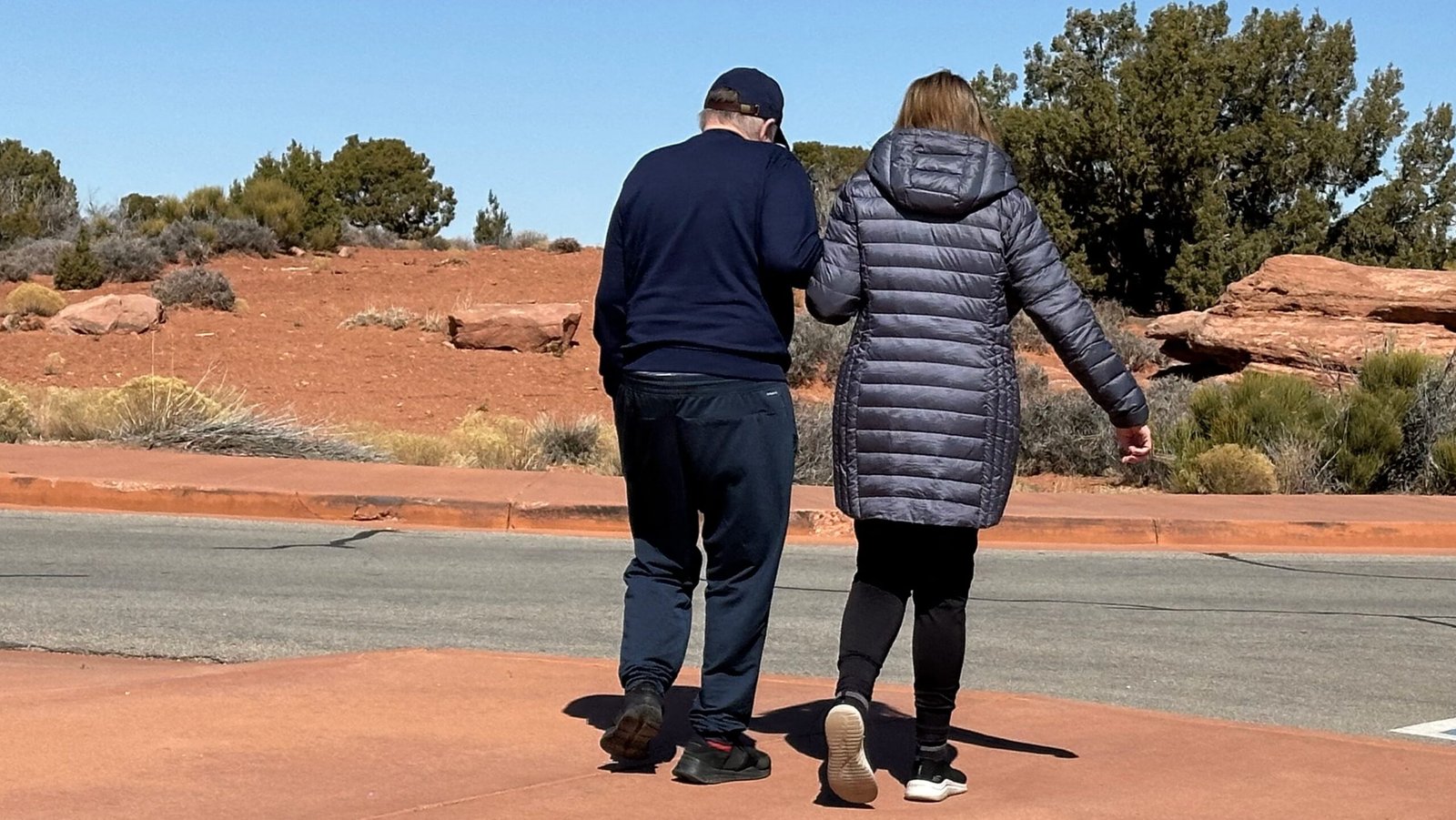
Meeting people where they are
Meeting people where they are
If there is someone you love whom you have not been able to reach, the work is not reaching harder — the work is crossing. On going to where someone actually stands, without losing yourself in the going.
We love to visit our grandkids. The scene usually looks something like this. We walk through the door and hear squeals as they run up to us. We pick them up and twirl them around, hugging them and telling them how much we love them. They usually hold on, long after we try to put them down to pick up the next one. We often have grandkids on both legs and one in our arms as we’re doing this. They laugh and smile, and just beam. I’m not sure there could be more love in such a small space.
We have learned, over years of being parents and now grandparents, that loving someone well is not always as natural as it is in those moments. Sometimes the people we love most are not running through the door toward us. Sometimes the distance between us and them has been growing for years, and we cannot figure out how to close it. We have extended the invitation. We have left the door open. We have stayed in the same place so they would always know where to find us. The space between us has not closed.
This post is for those relationships. We want to suggest, gently, that the work is not reaching harder. The work is meeting them where they are.
What meeting means
To meet someone where they are is to come to the place they are actually standing — not the place you wish they were, not the place that would make them easier to love, not the place from which a relationship would be more convenient. The place they actually are.
Most of the time, this is a place of the heart. Where they stand emotionally. Where their faith is, or isn’t. Where they have landed in their convictions, their understanding of love, their picture of who they are. To meet them where they are is to go to that interior address — not as an inspector, not as a corrector, but as someone who has decided to know them. It is a posture more than a location. The person who has decided to meet someone where they are has decided, ahead of time, that they will not flinch at what they find. They will not turn the visit into a chance to fix what they see. They will be there, fully present, in a place they may not have stood before.
Sometimes the meeting is emotional but expressed through what we can do at a distance. A phone call where we let them say what they are actually thinking rather than steering toward safer topics. A letter or text that asks a real question and waits for a real answer. Remembering what they told us last time and asking about it again. Reaching out on a day we know is hard. The geometry is the same. We are going to where they are, in the only way the relationship allows.
Sometimes the meeting is literal. Driving the extra hour. Eating at their table rather than asking them to come to yours. Hosting them in your spare bedroom rather than in some emotionally neutral middle ground. Calling instead of waiting to be called. With our grandkids, we have discovered something simple and powerful about literal meeting. When we get down on the floor with them and play at their level, they can feel it. Whatever doubt they might have had about whether we were really there for them disappears. They know. The whole-body recognition of being met is one of the first kinds of love a person ever feels, and it does not stop mattering when we get older.
But physical presence is not the same as emotional presence. Visiting someone only to preach to them, or to point out where they have gone wrong, is not meeting them. The location of the conversation has changed; the geometry has not. We have arrived at their door without ever having arrived at them.
Demanding that they come to you is not meeting them either. It can feel like meeting them — I have left the door open; I have made clear they are welcome — but the geometry is wrong. They are still standing where they have always stood. You are still standing where you have always stood. The gulf between you is unchanged. Welcome at your address is not the same as presence at theirs.
The parable of the prodigal son makes this visible. The father sees his son while he was yet a great way off and runs to him. He does not wait at the house. He does not stand on the porch with his arms folded, watching the road. He runs. The meeting happens out where the son is, dust-covered and rehearsing his apology — not in the dining room where the meal will eventually be served.
Why we don’t
If meeting people where they are is so simple to describe, why is it so hard to do?
We don’t go because we are afraid it will look like we agree.
We don’t go because we are afraid of what people will think.
And underneath both of these, sometimes, we are afraid that going to them will change us in ways we cannot predict.
The first fear is the loudest. If I sit in my daughter’s apartment and ask about her life without correcting it, am I endorsing it? If I love my brother and his husband fully, what does that say about everything I have been taught? If I go to a friend who has left the faith and listen to his reasons without arguing, have I given up something I was supposed to defend? The worry is real, and it has been reinforced by communities that read presence as agreement and listening as drift.
The second fear is quieter but it holds people in place just as effectively. What will my family say. What will my friends say. What will my church say. What will people think of me. We do not pretend this fear is unfounded. We have felt it ourselves. Every time we have crossed, the thought has been there. But in our own experience, what we feared has rarely been what came. The people whose regard turned out to matter most were also the people most willing to meet us with kindness when we crossed. The rest mattered less than we thought it would.
The third fear is the deepest, and most of us do not have words for it yet. It is the fear that if we go to where someone else stands, we will not be able to come back the same. That something in us will shift. That we will lose, somehow, the ground we have been standing on. Most readers will not have named this for themselves, but for many of us it is operating underneath the other two, holding us in place even after the others have been answered.
What we want to say, to all three fears at once, is that the self that crosses does not become a smaller self. We will return to this, because it is the heart of what we have learned. But for now, simply: none of these fears, however real, finally turns out to be the thing we thought it was.
What meeting actually requires
It does not require giving up what you believe.
It does not require pretending to agree with where the other person stands.
It does not require softening your convictions, abandoning your tradition, or becoming a different person than the one you have been.
What it requires is that you stop using your convictions to keep the person at a distance.
Your beliefs come with you when you cross. They sit beside you at their table. They are still yours. You arrive as yourself — beliefs and history and conviction and character, all of it intact — in the place where they are actually standing. Nothing of you is required to disappear for the meeting to happen.
Part of what makes meeting possible, we have come to believe, is recognizing the limits of our own certainty. The longer we have lived, the more we have learned. The more we have learned, the more clearly we see what we do not yet know. Our convictions are real. We hold them. But we hold them now with the awareness that any of us, at any moment, may be the one whose certainty is partly mistaken. This makes it easier to listen. To be with someone whose conclusions differ from ours becomes a chance to learn rather than a threat. We give others grace partly because we have come to understand how much grace we ourselves rely on.
Underneath all of this is something we hold above any particular certainty: love is the highest standard. When something we are certain about is preventing us from loving fully, the thing to examine is not the loving. It is the certainty — not necessarily what we believe, but how we are holding it. Love is the test that tells us whether our convictions are being applied in the direction God meant them.
Meeting others doesn’t mean losing yourself. It means finding someone else.
Dinner
One of our daughters went through a very difficult time some years ago that included a divorce and walking away from the church. For a long stretch, she did not talk with many members of her family. I was not in the picture yet. When she and Val finally began to talk again, it was still careful — both sides moving around certain topics that everyone knew not to raise.
By the time I came into her life, six months after Val and I were married, the careful shape of her reconnection with the family had hardened into a kind of architecture. She and I were kind to one another. We did not really know one another.
One evening Val and I texted her and asked if she and her husband would like to get Indian food. He was busy, so she came alone.
I am still not sure why, but somewhere in that dinner I told her how much I loved her and that I wanted to know her better. And then I asked her every forbidden question. Tell me about your kids. Tell me about your divorce. Tell me about the church and where you are with it. Every question I had been told, by long practice, not to ask.
With every question I asked, I kept thinking how much I loved her. I wanted her to feel that. I wanted her to know that we respected her and the decisions she had made.
When I asked about the church, she said she was definitely not coming back. I told her that was just fine. I just wanted to understand. And I told her that I didn’t know but what God was just fine with her decision.
She answered every question. She got emotional once or twice, which she rarely does. We talked for twenty or thirty minutes. Val sat quietly the whole time, listening, in something like shock — not because of anything that was said, but because she could feel something happening between us that neither of us had a name for yet.
When we talked about it afterward, Val and I both felt as if we had been given a glimpse of how this work is supposed to go. I had not asked the questions to change her. Not in any of the ways someone might have hoped to. Not to bring her back to anything. Not to soften her on anything. Not even with the back-of-the-mind hope that something I said might shift her. None of that was in my mind. I just wanted to know her. I wanted her to feel how much I loved her. And I think this is where many conversations of this kind fail. The person reaching out is also, secretly, hoping the conversation will move the other person. The other person feels it. They can always feel it. Meeting someone where they are means going there without an agenda for them — without even the most gently held one. The change in them, if it comes, is not yours to bring about. Your work is to love them. That is all.
I had not changed my beliefs to ask the questions. I had not changed them to receive her answers. But neither had I set them aside in order to love her. The love and the belief were not separate things that I was holding in two hands and trying to keep from touching. They were one thing. What I was setting down was not my convictions but the posture that had been using my convictions to keep her at a distance. Once that posture was gone, the love and the belief simply went together — the way, I think now, they were always meant to.
The dinner did not fix everything. It was not a single conversation that closed a long gulf. But it changed the geometry. She has continued to come a little closer. We have continued to receive what she is willing to give us. The relationship is realer than it was. And it became realer the moment I stopped pretending that the things I was not allowed to ask about did not exist.
I had a coworker for a while — I’ll call him Brian — whom I had to depend on to get certain projects across the finish line. Brian would often go silent when I emailed or texted. When we finally connected, he would make promises he didn’t keep. It was very frustrating, and for a while I dealt with it the way most of us deal with a frustrating coworker. I complained to my husband. I wondered out loud what was wrong with him.
One day I decided to try something different. I had been wanting him to be reliable for me. I had been wanting him to finish the projects, return the emails, keep the promises. I decided to stop wanting him to be different. I decided to meet him where he was instead of where I needed him to be.
I started reaching out about him rather than about the work. How was he doing. What was going on. What did his weekends look like. I tried to actually know him, not because it was a strategy, but because I wanted to. Slowly — and then less slowly — I began to understand. He was carrying far more than the projects I knew about. He was overwhelmed in ways he had not been able to say. His silence was not indifference. It was the only way he had to hold all of it.
Once I understood, I stopped trying to get my work done through him. I started trying to help him succeed. Within a couple of weeks, we were friends. We have been friends ever since.
It does not mean my projects always get finished on time. They don’t. But Brian and I understand each other now. We work together rather than past each other. And I have learned, again, that meeting people where they are is not just for the hard family ruptures or the long, painful estrangements. It is for the everyday people in our everyday lives. It changes everything it touches.
What it costs
Meeting people where they are does not always produce results — at least not in the way you want them, or on the timeline you want them. Some of the people we have crossed toward have crossed back. Some have not. Some have come a little closer and stayed at that distance. Some are still standing right where they were when we began.
We have a relationship in our own family — we will not say more about it than this — where the meeting has gone in one direction for a long time now. We continue to go where they are, in the ways we can. We continue to love them in the way they need to be loved, which is very different from the way we would have chosen. And we have learned to receive whatever they are willing to give, without asking for more.
This is the harder face of the work. The post would be dishonest if it pretended otherwise.
But here is the thing we have most come to believe. The person who crosses, and keeps crossing, does not become a smaller person for the crossing. If anything, what is already in us grows. Our capacity to see grows. Our capacity to understand grows. Our capacity to care grows. Our capacity to love grows. The convictions we carried in with us are still there, but some of the misperceptions we did not even know we were carrying have started to fall away. We become more of who we already were. The good in us enlarges.
And we have also discovered — slowly, sometimes without noticing — that the love we keep giving has been doing its own quiet work in us. Not healing the wound the relationship caused. That is a different work, and a slower one. But the love itself, as we have given it, has shaped us. We are softer where we were brittle. We are steadier where we used to be afraid. The love we have given away has changed us in directions we did not predict.
The fear we had — that crossing might shrink us — turns out to have been a fear of the wrong thing entirely. We were never being asked to disappear in order to be acceptable. We were being invited to arrive, fully who we are, in a place we had not yet stood. And in arriving, we have found that we are larger than we knew.
When the meeting becomes mutual
Sometimes — and this is one of the gifts of the work — the meeting becomes mutual. Someone goes first. The other person, eventually, steps into the gap. They both move toward the middle. The friendship that grows from that kind of meeting is often the deepest kind there is.
We know this because we have seen it happen. Someone in our family had a hard stretch with their mother in high school. In her twenties, she went to her mother — literally — and they began to talk. It was not a single conversation. It was the work of weeks and months and longer. They listened. They talked. They listened more. It took effort on both sides. But by the end of the work, they were best friends. They stayed best friends until her mother died a few months ago.
Someone has to move first. But once someone has, the other person often finds they can move too. Healings happen. Miracles happen. They happen often enough that we have come to expect them when we see the first move being made.
The same work, in two motions
We have written elsewhere on this site about loving people in their language — about the work of learning how a particular person actually receives love, and giving it to them in that form rather than in the form we would have given by default.
This post is about the move that comes before. Before you can love someone in their language, you have to be standing close enough to hear what their language is. The meeting comes first; the loving follows. Meeting people where they are is what makes loving in their language possible.
Close
The work of meeting people where they are is, in the end, the work of love itself. Love that does not cross is love at a distance — real, perhaps, but unable to land. Love that crosses is the love that changes things.
Most of us already know the person we need to go to. They have been on our minds, sometimes for years. We have known for a long time that the gap between us is not closing on its own.
You do not have to make a plan to fix everything. You do not have to know what the relationship will eventually become. You only have to take the next step toward them — not toward where you wish they were, but toward where they actually are.
Bring yourself when you go. All of you. Beliefs and history and conviction and the person you have become over a whole life. None of it has to be left behind. What is enlarged, when we meet them, is what was already in us.
Meeting others doesn’t mean losing yourself. It means finding someone else.
Who comes to mind as you read this — and what would the next step toward them look like?
Share a thought in the comments below.